Mizoram Civil Service Exam Notes | Environment Series
Lecture 6 is extremely important for UPSC and MPSC — it covers Loss of Biodiversity, Mass Extinctions, Biodiversity Conservation methods, Biodiversity Hotspots, India’s 4 Hotspots in detail, and key committees like Gadgil Commission and Kasturirangan Panel. This topic comes up in almost every prelims paper.
Loss of Biodiversity
- According to the IUCN Red List (2004), 784 species have gone extinct in the last 500 years.
- Since the origin and diversification of life on Earth, there were five episodes of mass extinction
The 5 Mass Extinctions
| Sl No. | Name | When (mya = million years ago) |
|---|---|---|
| 1 | Ordovician–Silurian extinction | 444 mya |
| 2 | Late Devonian extinction | 383–359 mya |
| 3 | Permian–Triassic extinction | 252 mya |
| 4 | Triassic–Jurassic extinction | 201 mya |
| 5 | Cretaceous–Paleogene extinction | 66 mya (dinosaurs wiped out) |
- Presently — the Sixth Extinction is in progress
The Sixth Mass Extinction
- Earth is currently experiencing a biodiversity crisis
- Recent estimates suggest extinction threatens up to a million species of plants and animals, largely because of human activities — deforestation, hunting, overexploitation, habitat and ecosystem destruction, pollution, climate change, invasive species, etc.
- Current species extinction rates estimated to be 100 to 1,000 times faster than in pre-human times
- Ecologists warn that if present trends continue, nearly half of all species on Earth might be wiped out within the next 100 years
UPSC 2018: The term “sixth mass extinction/sixth extinction” is often mentioned in news in the context of?
Answer: (d) Mankind’s over-exploitation/misuse of natural resources, fragmentation/loss of natural habitats, destruction of ecosystems, pollution and global climate changeUPSC 2018: Why is a plant called Prosopis juliflora often mentioned in news?
Answer: (b) It tends to reduce the biodiversity in the area in which it grows (invasive species)
Biodiversity Conservation
Conservation can be done both In-situ and Ex-situ:
| In-situ (On-site) | Ex-situ (Off-site) |
|---|---|
| Biodiversity Hotspots | Zoological Parks |
| Biosphere Reserves | Botanical Gardens |
| National Parks | Wildlife Safari Parks |
| Sanctuaries | Seed Banks |
| Reserved Forests | Germplasm Banks |
| Protected Forests | |
| Nature Reserves | |
| Sacred Groves |
UPSC 2012: Which one is NOT a site for in-situ method of conservation of flora?
Answer: (b) Botanical Garden (Botanical Gardens are Ex-situ)UPSC 2014: The most important strategy for the conservation of biodiversity together with traditional human life is the establishment of?
Answer: (d) Biosphere Reserves
The official UPSC answer key marks this as Biosphere Reserves.
The defining characteristic of a Biosphere Reserve (under UNESCO’s Man and the Biosphere programme) is that it explicitly integrates human settlements, sustainable tribal life, and traditional modes of living within its buffer and transition zones. National Parks, by contrast, strictly exclude human habitation and resource exploitation under the Wildlife Protection Act, 1972.
Biodiversity Hotspots
- Concept given by Norman Myers
- A biodiversity hotspot is a bio-geographic region that is both:
- A significant reservoir of biodiversity, AND
- Threatened with destruction
- Most hotspots are located in the tropics but not confined to tropics
- These regions are under threat from humans
Criteria to Qualify as a Biodiversity Hotspot
A region must meet two strict criteria:
- It must have at least 1,500 vascular plants as endemics (found only in that place — e.g., Muga silk in Assam)
- It must have a high percentage of plant life found nowhere else on the planet
- A hotspot, in other words, is irreplaceable
- It must have 30% or less of its original natural vegetation remaining (i.e., 70% destroyed)
- In other words, it must be threatened
UPSC 2011: Three criteria that contributed to recognition of Western Ghats–Sri Lanka and Indo-Burma regions as hotspots of biodiversity:
- Species richness 4. Ethno-botanical importance
- Vegetation density 5. Threat perception
- Endemism 6. Adaptation of flora & fauna to warm & humid conditions
Answer: (c) 1, 3 and 5
Biodiversity Hotspots Around the World
- Around the world, 36 areas qualify as hotspots (Latest addition: The North American Coastal Plain)
- They represent just 2.5% of Earth’s land surface (official figure recognized by Conservation International—especially after the addition of the 36th hotspot—is 2.5%
- But they support more than half of the world’s plant species as endemics
- And nearly 43% of bird, mammal, reptile and amphibian species as endemics
- Biodiversity hotspots are identified by Conservation International (CI)
PSC 2017: The number of biodiversity hotspots in the world is?
Answer: (d) 36UPSC 2010 (Statements):
- Biodiversity hotspots are located only in tropical regions ❌ (FALSE — not confined to tropics)
- India has four biodiversity hotspots i.e., Eastern Himalayas, Western Himalayas, Western Ghats and Andaman and Nicobar Islands ❌ (FALSE — India’s 4 hotspots are different)
Answer: (d) Neither 1 nor 2
Biodiversity Hotspots in India
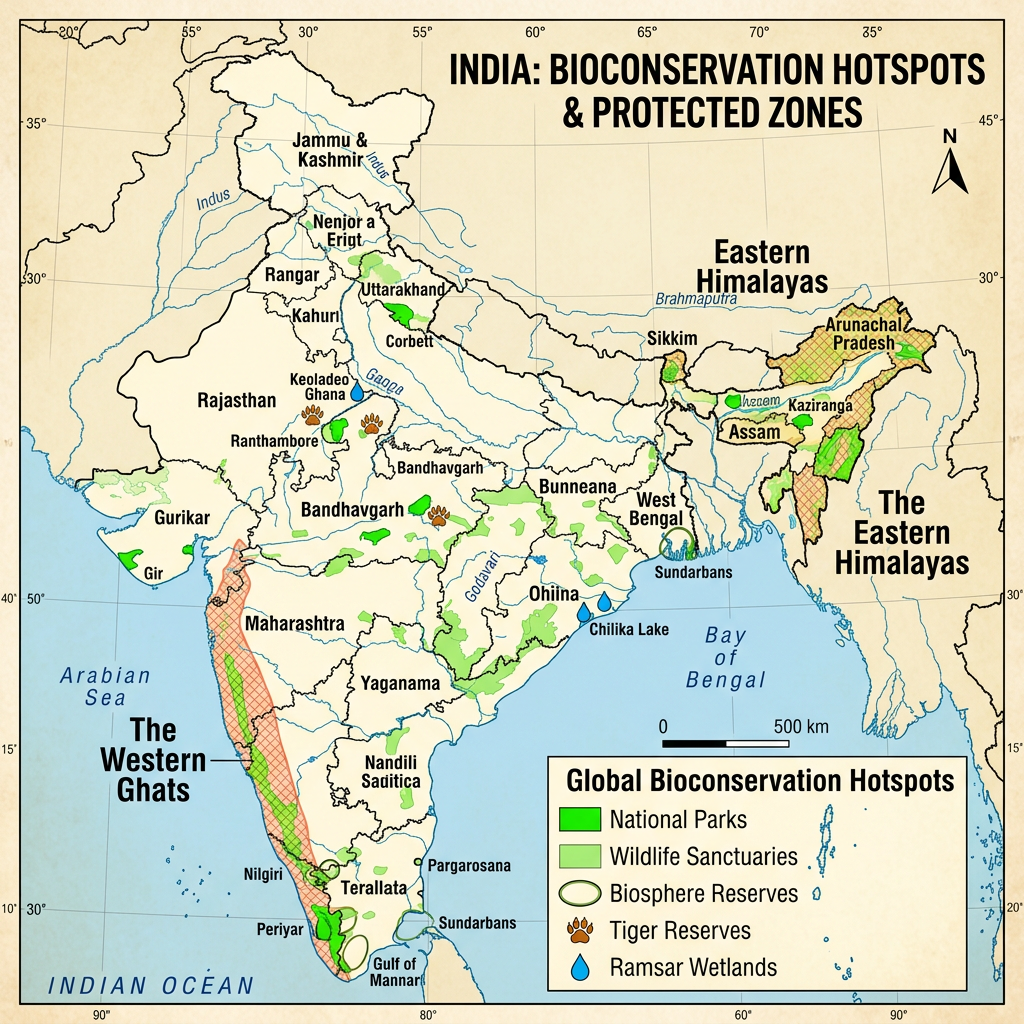
Four hotspots fall within Indian territory:
- The Himalayan Hotspot
- Indo-Burma Hotspot (Mizoram)
- Western Ghats and Sri Lanka
- Sundaland Hotspot
(Note: The Andaman Islands fall under the Indo-Burma hotspot, while the Nicobar Islands fall under Sundaland)
Practice Question: Which biodiversity hotspots fall within Indian territory?
- Indo-Burma region 2. Western Ghats and Sri Lanka 3. Sundaland 4. Madagascar and Indian Ocean Islands
Answer: (c) 1, 2 and 3 only (Sundaland has a small part in Indian territory; Madagascar is NOT in India)
Practice Question: Which global biodiversity hotspots are located in India either partly/completely?
- The Himalayas 2. Indo-Burman region 3. Western Ghats 4. Sundaland 5. Madagascar and Indian Ocean Islands
Answer: (c) 1, 2, 3 and 4 only
India’s Hotspots in Detail
1. The Himalayan Hotspot
- Home to the world’s highest mountains, including Mt. Everest
- Mountains rise abruptly — creating a diversity of ecosystems (bio-geography)
- Vascular plants have been recorded at more than 6,000 metres
- Spans India, China, Nepal, Bangladesh, Bhutan, Myanmar
Flora:
| Western Himalayas | Eastern Himalayas |
|---|---|
| Chir, Pine, Conifers | Oaks, Laurels |
| Broadleaved temperate trees | Maples, Rhododendrons |
| Deodar, Blue Pine | Alder, Birch |
| Spruce, Silver Fir |
UPSC 2014: If you travel through the Himalayas, you are likely to see which of the following plants naturally growing there?
- Oak 2. Rhododendron 3. Sandalwood
Answer: (a) 1 and 2 only (Sandalwood is NOT found in Himalayas)
MPSC 2011: The Himalayan Range is very rich in species diversity. Which among the following is the most appropriate reason for this phenomenon?
Answer: (b) It is a confluence of different bio-geographical zones
2. Indo-Burma Hotspot
- Encompasses more than 2.3 million km² of tropical Asia
- One of the richest yet very fragile hotspots
- Also holds remarkable endemism in freshwater turtle species
- Bird life: holds almost 1,300 different bird species including:
- The white-eared night heron
- The grey-crowned crocias
- The orange-necked partridge
3. Western Ghats and Sri Lanka
- Rich endemic assemblage of plants, reptiles and amphibians
- Sri Lanka alone may be home to as many as 140 endemic species of amphibians
Western Ghats — Key Facts:
- Mountain range along the western side of India
- Runs north to south along the western edge of the Deccan plateau
- Separates the plateau from a narrow coastal plain along the Arabian Sea
- Spanning over 6 states, 44 districts and 142 taluks
- Starts near the border of Gujarat and Maharashtra (south of Tapti river)
- Runs ~1,600 km through Maharashtra, Goa, Karnataka, Tamil Nadu and Kerala
- Ends at Kanyakumari at the southern tip of India
- Covers 160,000 km² — forms catchment area for complex riverine drainage systems
- Average elevation: 1,200 metres
- Western Ghats are older than the Himalaya mountains
- High mountain forest ecosystems influence the Indian monsoon weather pattern
- Moderates the tropical climate and presents one of the best examples of monsoon system in the planet
Biodiversity of Western Ghats:
- Exceptionally high level of biodiversity
- Home to at least 325 globally threatened flora, fauna, bird, amphibian, reptile and fish species
- One of the world’s ten “Hottest biodiversity hotspots”
- More than 1,500 endemic species of flowering plants
- At least 500 species of fishes, amphibians, reptiles, birds and mammals
Endemic species found:
- Malabar large-spotted civet
- Lion-tailed macaque
- Crimson-backed sunbird
- Nilgiri Marten
- Grey Horn Bill
- Cochin Cane Turtle
- Common Green Forest Lizard
Other endangered species:
Asian elephants, Sloth Bear, Black panther, Leopard, Tiger, Sambar, Wild Boar, Great Indian Hornbill
UPSC 2013: In which states is Lion-tailed macaque found in its natural habitat?
- Tamil Nadu 2. Kerala 3. Karnataka 4. Andhra Pradesh
Answer: (a) 1, 2 and 3 only
UPSC 2013: In which regions of India are you most likely to come across the ‘Great Indian Hornbill’ in its natural habitat?
Answer: (d) Western Ghats
Important Protected Areas in Western Ghats:
- Nilgiri Biosphere Reserve — 5,500 sq km; evergreen forests of Nagarahole and deciduous forests of Bandipur in Karnataka; adjoining regions of Wayanad-Mukurthi in Kerala
- Mudumalai National Park–Santhyamangalam (Tiger Reserve) — links Eastern and Western Ghats in Tamil Nadu; forms the largest contiguous protected area in the Western Ghats
- Silent Valley in Kerala — among the last tracts of virgin tropical evergreen forest in India
UPSC 2017: From ecological point of view, which assumes importance in being a good link between the Eastern Ghats and the Western Ghats?
Answer: (a) Santhyamangalam Tiger Reserve
Threat to Western Ghats:
- The Ghats have shrunk by 25% over past decades
- Will affect rainfall patterns, river flow, water supply and climate across the country
Western Ghats Ecology Expert Panel (WGEEP) — Gadgil Commission
- Also known as the Gadgil Commission after its Chairman Madhav Gadgil
- It was an environmental research commission
- Submitted report to Government of India on 31 August 2011; released in public domain in 2012
Main aspects:
- Designated the entire hill range as an Ecologically Sensitive Area
- Classified 142 taluks in the Western Ghats boundary into Ecologically Sensitive Zones (ESZ) 1, 2 and 3
Key recommendations:
- No new hydro-electric projects in ESZ 1
- No new polluting industries (including coal-based power plants) in ESZ 1 and 2
- No new mining clearance in ESZ 1 and 2
- Moratorium on new clearances in ESZ 2 (can be revisited when situation improves)
- Existing red and orange category industries should switch to zero pollution by 2016 with social audit
- A statutory authority — Western Ghats Ecology Authority (WGEA) — proposed under Environment (Protection) Act, 1986 (most powerful)
The Response (Opposition):
- Report faced unanimous opposition from state governments
- Mainly for recommending that almost three-fourths of the hills (including plantations, cultivated lands, large habitations) be turned into restricted development zones
- Felt the report was proposing an over-arching authority to regulate the region, superseding elected authorities
Kasturirangan Panel on Western Ghats
- Set up to study the Gadgil Committee report on Western Ghats
- Advised bringing cultivated lands, plantations and habitations outside Ecologically Sensitive Area (ESA)
- Suggested that 90% of the natural forests left in Western Ghats complex — adding up to 60,000 sq km (37% of entire hilly belt) — be conserved under ESA provisions
- The forest area falling within the ESA would also cover 4,156 villages across the six states
Kasturirangan Recommendations:
- Ban on hydroelectric projects in the zone (while the Gadgil Commission proposed a blanket ban on new large dams, the Kasturirangan Panel did not ban them entirely. Instead, it allowed them subject to strict environmental clearances and a mandate to maintain an uninterrupted ecological flow of at least 30% of the river’s baseline flow).
- Complete ban on mining activity in ESA zone
- Current mining activities to be phased out within five years
- Development of any township or construction over 20,000 sq m in ESA zone should be banned
- Stricter clearances for dams and other projects
- For dams, an uninterrupted ecological flow of at least 30% level of the rivers’ flow
UPSC 2016: ‘Gadgil Committee Report’ and ‘Kasturirangan Committee Report’, sometimes seen in news, were related to?
Answer: (d) Protection of Western Ghats
4. Sundaland Hotspot
- Covers the western half of the Indo-Malayan archipelago
- An arc of some 17,000 equatorial islands
- Dominated by two of the largest islands in the world: Borneo and Sumatra
- Sundaland is one of the biologically richest hotspots on Earth
- Holds about 25,000 species of vascular plants; 15,000 (60%) of which are found nowhere else
- Covers: Thailand, Malaysia, Singapore, Brunei, Philippines, Indonesia (Java, Bali, Kalimantan/Borneo)
Quick Revision Summary
| Topic | Key Point |
|---|---|
| 5th mass extinction | Cretaceous–Paleogene; 66 mya; dinosaurs |
| 6th mass extinction | Currently in progress; human-caused |
| Botanical Gardens | Ex-situ conservation (NOT in-situ) |
| Biodiversity hotspot concept | Norman Myers |
| Hotspot criteria 1 | ≥1,500 endemic vascular plants |
| Hotspot criteria 2 | ≤30% original vegetation remaining |
| Total global hotspots | 36 (identified by Conservation International) |
| Hotspots cover | 2.4% of Earth’s land; >50% of endemic plant species |
| India’s 4 hotspots | Himalayas, Indo-Burma, Western Ghats+Sri Lanka, Sundaland |
| Western Ghats length | ~1,600 km; older than Himalayas |
| Gadgil Commission | WGEEP; 2011 report; ESZ 1, 2, 3 classification |
| Kasturirangan Panel | 37% of Western Ghats as ESA; 4,156 villages affected |
| Silent Valley | Last virgin tropical evergreen forest in India |
| Santhyamangalam | Links Eastern and Western Ghats |
| Sundaland | Borneo + Sumatra; 25,000 vascular plant species |
These notes are based on my personal coaching class notes for Civil Services Exam preparation.
← Read Lecture 5 | Stay tuned for Lecture 7 — Protected Areas, Biosphere Reserves & Wildlife Conservation!
Found this helpful? Share it with fellow aspirants!