Mizoram Civil Service Exam Notes | Environment Series
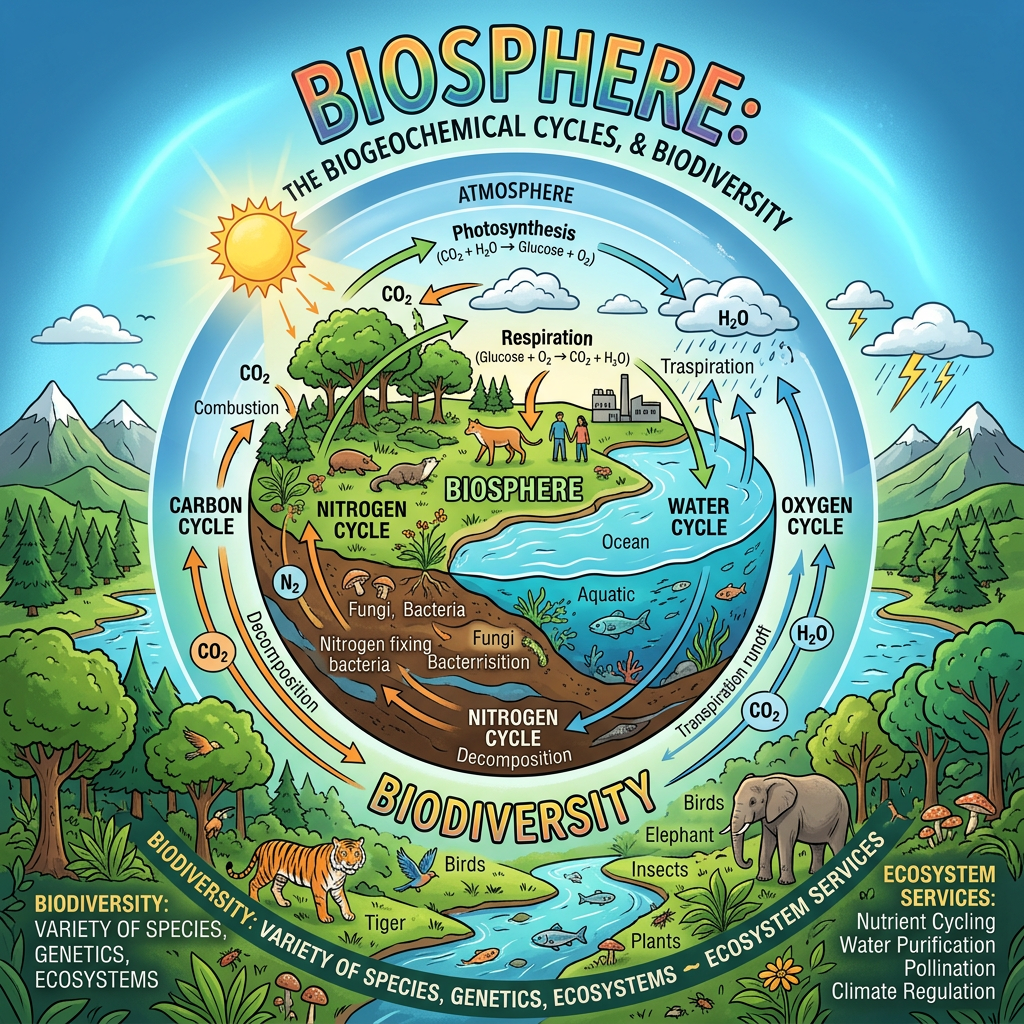
Lecture 5 is one of the most important for civil services exams. It covers Threats to Biomes, the Biosphere, all major Biogeochemical Cycles (Water, Nitrogen, Carbon, Sulphur, Phosphorus), and then begins Biodiversity — its meaning, value, threats, and invasive species.
Threats to Biomes
Terrestrial Biome Threats
| Biome | Major Threats |
|---|---|
| Tropical Rainforest | Deforestation/logging, loss of animals and plants for commercial trade, slash and burn (jhum) agriculture |
| Temperate Deciduous Forest | Urbanization, agricultural conversion, and fragmentation |
| Temperate Rainforest | Commercial logging and deforestation |
| Boreal Forest (Taiga) | Acid rain, industrial logging, and climate-induced pest outbreaks |
| Grasslands | Overgrazing, conversion to intensive agriculture, and ranch land |
| Desert | Recreation/tourism, off-road vehicle damage, deposition of hazardous waste, and disruption from massive utility-scale solar arrays |
| Chaparral | Wildfire suppression imbalances, tourism, and rapid urbanization |
| Tundra | Oil and gas exploration, permafrost thaw due to climate change |
Aquatic Biome Threats
Freshwater:
- Dams, diversion of rivers, agricultural runoff, and industrial pollution.
- Introduction of aggressive invasive species.
- Draining and encroachment of wetlands for urban development.
Habitat-Specific Threats
Forests: Deforestation (particularly in the rainforest), commercial logging, power generation, agricultural expansion, and the paper industry.
Tundra: Climate change, invasive species, and industrial pollution.
Deserts: Excessive evaporation rates, wildfires, and pollution damage.
Grasslands: Unsustainable agricultural practices, disease, pests, overdependence on pesticides, and shifting weather patterns due to global warming.
Marine:
- Overfishing, plastic pollution, and catastrophic oil spills.
- Ocean acidification destroying coral reefs.
UPSC Question: Which are unique characteristics of equatorial forests?
- Presence of tall, closely set trees with crowns forming a continuous canopy
- Coexistence of a large number of species
- Presence of numerous varieties of epiphytes
Answer: (d) 1, 2 and 3
Biosphere
- The biosphere is the global ecosystem — the sum of all the planet’s ecosystems integrated.
- Term originally coined by Austrian geologist Eduard Suess (1875).
- It represents the broadest scale of ecology — encompassing every portion of Earth inhabited by life.
- Life evolved roughly 3.5 to 3.8 billion years ago via biogenesis.
What Makes Earth Special for the Biosphere? (G. Evelyn Hutchinson)
- It is a region in which liquid water can exist in substantial quantities.
- It receives an ample, continuous supply of energy from an external source (the Sun).
- Within it, there are active interfaces between the liquid, solid, and gaseous phases of matter.
Components of Biosphere
| Biotic (Living Components) | Abiotic (Non-Living Components) |
|---|---|
| Producers (Autotrophs) | Water (Hydrosphere) |
| Consumers (Heterotrophs) | Soil / Rocks (Lithosphere) |
| Decomposers (Fungi, Bacteria) | Temperature / Sunlight |
| Detritivores | Air / Gases (Atmosphere) |
Biogeochemical Cycles
- H, C, O, and N make up roughly 99% of the mass of most living cells.
- H, O, C, N, P, S form the core protoplasm of all living organisms.
- These elements are recycled infinitely between the biotic and abiotic worlds via Biogeochemical cycles.
- Unlike energy (which flows lineally and dissipates), matter cycles closed-loop within the biosphere.
1. Water Cycle (Hydrological Cycle)
Key processes: Evaporation, Transpiration (Evapotranspiration), Condensation, Precipitation, Infiltration, and Surface/Groundwater Runoff.
MPSC 2013: The repeated movement of water between Earth’s surface and the atmosphere is called?
Answer: (a) The water cycle
2. Nitrogen Cycle
Atmospheric N2 accounts for 78% of the air but is chemically unreactive and cannot be used directly by most organisms.
Key steps in Nitrogen Cycle:
| Process | Description |
|---|---|
| Nitrogen fixation | Atmospheric N2 → Ammonia/Nitrates; achieved via biological fixers (Rhizobium, Azotobacter), atmospheric lightning, and industrial synthesis (Haber-Bosch process). |
| Nitrification | Ammonium (NH₄⁺) → Nitrites (NO₂⁻) → Nitrates (NO₃⁻). Done by Nitrosomonas and Nitrobacter bacteria respectively. |
| Assimilation | Plants absorb nitrates or ammonium ions through roots to form plant proteins; animals ingest these plants. |
| Ammonification (Mineralisation) | Decomposers convert organic nitrogenous waste (urea, dead matter) back into inorganic Ammonia (NH3). |
| Denitrification | Nitrates (NO3–) are converted back into gaseous Nitrogen (N2), escaping to the atmosphere. Processed by Pseudomonas and Thiobacillus in anaerobic conditions. |
| Immobilisation | The opposite of mineralization; inorganic nitrogen compounds are absorbed by microbes and temporarily locked out of plant reach. |
Exam Question: The organism which converts ammonia into nitrite during nitrification is:
Answer: Nitrosomonas bacteriaUPSC Question: Consider the following statements regarding the Nitrogen cycle:
- Mineralisation is the process where organic nitrogenous compounds are broken down into inorganic ammonia. ✅
- Most plants can absorb nitrogen directly from soil in the form of both nitrates (NO3–) and ammonium (NH4+) ions. ✅
Answer: (c) Both 1 and 2
3. Carbon Cycle
Carbon reservoirs: Ocean waters & deep marine sediments (largest functional pool), Carbonate rocks (crustal storage), Fossil fuels, Soil organic matter, Terrestrial biomass, and Atmospheric CO2.
Key processes:
- Photosynthesis: Fixes atmospheric CO2into organic carbohydrates.
- Respiration & Decomposition: Releases CO2 back into the environment.
- Combustion: Burning of fossil fuels rapidly transfers long-term lithospheric carbon back to the atmosphere.
UPSC Question: In which part of Earth is the maximum amount of carbon stored long-term?
Answer: (d) Carbonate rocks and deep ocean sediments
4. Sulphur Cycle
- Both Sedimentary & Gaseous: Has reservoirs in both Earth’s crust (rocks/evaporites) and the atmosphere (SO2 / H2S).
- Enters atmosphere via volcanic eruptions, combustion of fossil fuels, and marine organic decay.
- Enters terrestrial/aquatic systems via precipitation (weak sulfuric acid/acid rain) and weathering, where plants assimilate it as inorganic sulphates.
- Gaseous Phase: Volcanic eruptions, decomposition, and fossil fuel combustion release Sulphur Dioxide and Hydrogen Sulphide into the atmosphere. This reacts with moisture to fall as acid rain (weak sulphuric acid).
- Sedimentary Phase: Sulphur is bound up in rocks as iron sulfides (FeS, FeS2) and sulfate salts. Weathering releases inorganic sulphates SO₄²- into the soil and water, which are directly assimilated by plants to form amino acids (like cysteine and methionine).
5. Phosphorus Cycle
- Strictly a Sedimentary Cycle: Has no significant atmospheric gaseous phase.
- Pathway: Phosphate Rocks → Weathering → Dissolved Soil Phosphates → Assimilation by Plants → Consumers → Decomposers → Sedimentation back into marine strata.
- Guano Deposits: Marine birds returning phosphorus from ocean fish back to coastal land masses form highly valuable phosphate resources.
- Limiting Factor: Because it washes into deep ocean sediments and takes millions of years to uplift back into rock, phosphorus is often the primary limiting nutrient in freshwater and terrestrial ecosystems.
V. Biodiversity
Meaning and Definition
- Biodiversity is a contraction of “biological diversity.”
- The term was coined by W.G. Rosen (1985), though the foundational concepts were used earlier by Raymond F. Dasmann (1968) and Thomas Lovejoy (1980).
- Definition: The totality of genes, species, and ecosystems of a given region.
- International Day for Biological Diversity: 22nd May
- World Biodiversity Day = 22nd May.
Three Fundamental Levels of Biodiversity
- Genetic diversity: Variation of genes within a single species population (e.g., thousands of distinct varieties of rice in India).
- Species diversity: The variety and abundance of different species within a specific region (measured by species richness and evenness)- e.g., the Western Ghats have a greater amphibian species diversity than the Eastern Ghats.
- Ecosystem diversity: The variety of habitats, biotic communities, and ecological processes across a landscape.(e.g., India’s mix of deserts, rainforests, mangroves, and coral reefs).
MPSC Previous Year Questions
The variety and variability of life amongst animals, plants and microorganisms is?
Answer: (a) Biodiversity
Exam Question: Arrange the following taxonomic groups in decreasing order based on the global number of described species:
- Vascular Plants 2. Insects 3. Fungi 4. Vertebrates
Answer: Insects > Vascular Plants > Fungi > Vertebrates (Insects vastly outnumber all other living macro-organisms).
Value of Biodiversity (Direct & Indirect)
- Direct Consumption (5Fs): Food, Fodder, Fuel, Fiber, and Pharmaceuticals.
- Ecosystem Services: Air/water purification, bioremediation, decomposition of organic wastes, pest regulation via natural predators, and crop pollination.
- Climate & Soil Stability: Moderation of floods/droughts, stabilization of shorelines via mangroves, and continuous maintenance of soil fertility.
UPSC 2011: Biodiversity forms the basis for human existence in the following ways:
- Soil formation 2. Prevention of soil erosion 3. Recycling of waste 4. Pollination of crops
Answer: (d) 1, 2, 3 and 4
Biodiversity Under Threat: The 6 Main Drivers
- Habitat Destruction & Loss: The single largest cause of modern extinctions (e.g., clearing rainforests for monoculture livestock/palm farming).
- Habitat Fragmentation: Breaking contiguous wild landscapes into small patches, inducing edge-effects and stopping genetic exchange.
- Overexploitation: Unsustainable hunting, poaching, and overfishing.
- Invasive Alien Species: Displacing indigenous flora and fauna.
- Environmental Pollution: Nitrogen loading, pesticide magnification, and toxic chemical runoffs.
- Global Climate Change: Shifting climatic envelopes faster than species can adapt or migrate.
UPSC 2012: Which can be threats to the biodiversity of a geographical area?
- Global warming 2. Fragmentation of habitat 3. Invasion of alien species 4. Promotion of vegetarianism
Answer: (a) 1, 2, 3 only
Major Invasive Alien Species in India (Exam Favorites)
An alien species is one introduced outside its native range. When its population explodes, it threatens indigenous ecological stability.
Invasive Flora (Plants) in India:
- Water Hyacinth (Eichhornia crassipes): Known as the “Terror of Bengal”; chokes wetlands and deoxygenates water bodies.
- Lantana camara: Aggressive terrestrial shrub invading forest understories across India, suppressing native forage.
- Parthenium hysterophorus: Commonly called Congress Grass or Carrot Weed; causes severe allergies and crowds out local grasses.
- Prosopis juliflora (Vilayati Kikar): Introduced to arid zones; aggressively depletes local water tables.
Invasive Fauna (Animals) in India:
- African Apple Snail (Achatina fulica): Severe agricultural pest destroying crops.
- Papaya Mealybug: Devastates horticultural crops.
- Amazon Sailfin Catfish: Found escaping into inland waterways, destroying local river ecosystems.
- Indian Bullfrog (Hoplobatrachus tigerinus): Note that while native to mainland India, it has become a highly destructive invasive alien species in the Andaman and Nicobar Islands, devouring endemic fauna.
Quick Revision Summary
| Topic | Key Point |
|---|---|
| Biosphere term coined by | Eduard Suess (1875) |
| Biogeochemical Core Elements | H, O, C, N, P, S |
| Nitrification Bacteria | Nitrosomonas (Ammonia → Nitrite) & Nitrobacter (Nitrite → Nitrate) |
| Sedimentary Cycle par excellence | Phosphorus Cycle (No atmospheric gas phase) |
| Biodiversity term popularized by | W.G. Rosen (1985) |
| International Biodiversity Day | 22nd May |
| Terror of Bengal | Water Hyacinth (Invasive aquatic weed) |
| Main Threat to Biodiversity | Habitat Destruction and Fragmentation |
These notes are based on my personal coaching class notes for Civil Services Exam preparation.
← Read Lecture 4 | Stay tuned for Lecture 6 — Biodiversity Conservation & Protected Areas!
Found this helpful? Share it with fellow aspirants!
hello world