Mizoram Civil Service Exam Notes | Environment Series
Lecture 4 wraps up Ecological Pyramids and then dives deep into Types of Ecosystems and all major World Biomes — a topic that appears in almost every civil services prelims paper. Memorize the key features of each biome and you’ll be well-prepared.
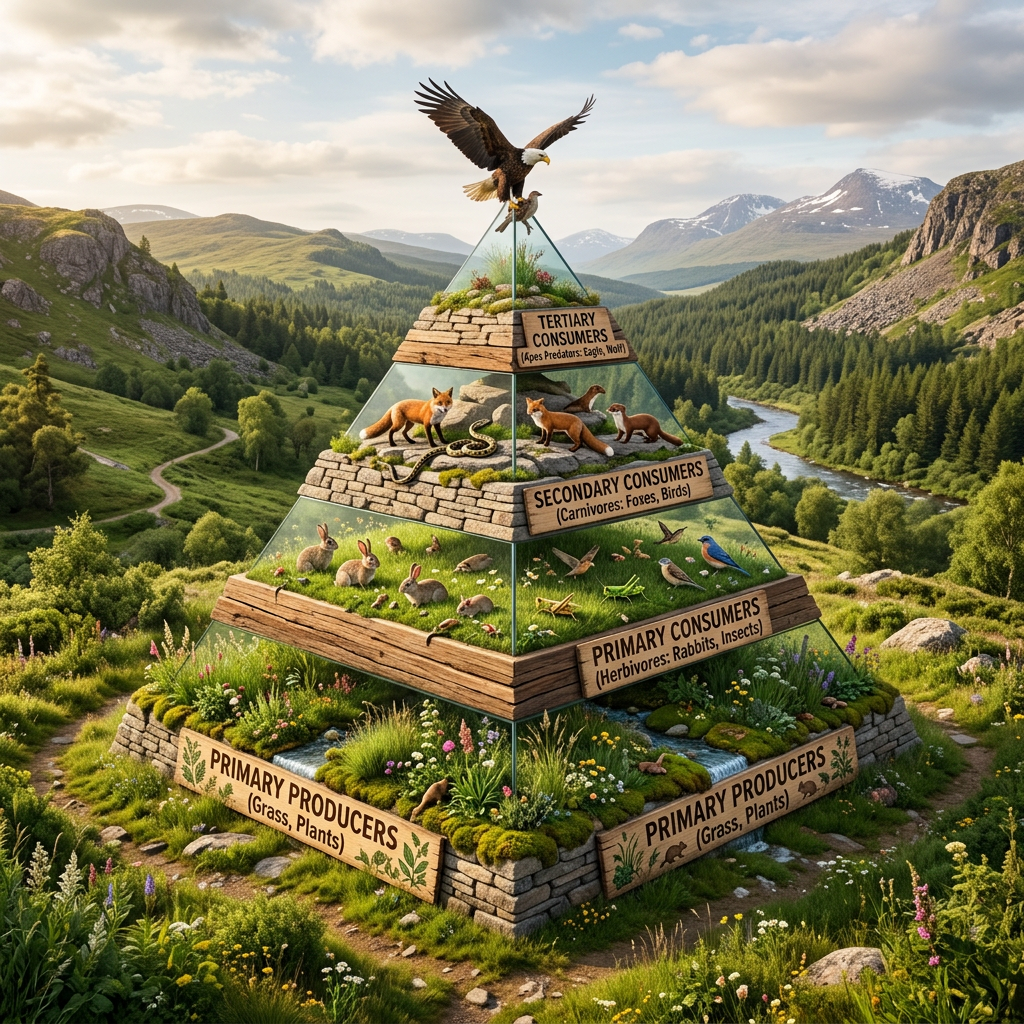
Ecological Pyramids (Continued from Lecture 3)
1. Pyramid of Numbers
This pyramid shows the total number of individual organisms at each trophic level. Unlike energy pyramids, the pyramid of numbers can take completely different shapes depending on the ecosystem.
| Ecosystem | Shape | Reason / Example |
|---|---|---|
| Grassland Ecosystem | Upright | Grasses (Millions) → Grasshoppers (Thousands) → Frogs (Hundreds) → Snakes (Tens) → Hawks (Few) |
| Aquatic (Pond) Ecosystem | Upright | Phytoplankton (Millions) → Zooplankton (Thousands) → Small Fish (Hundreds) → Large Fish (Few) |
| Single Tree Ecosystem | Spindle-shaped | One massive Oak Tree (1) → Herbivorous Insects/Birds (Hundreds) → Carnivorous Birds (Few) |
| Parasitic Food Chain | Inverted | One massive Tree (1) → Herbivorous Birds (Tens) → Parasites/Lice (Thousands) → Hyper-parasites (Millions) |
Exam Trap Warning:
A common question tests the “Single Tree” vs. “Parasitic” chain. If a question asks about a single tree supporting herbivorous birds and their parasites, the pyramid becomes completely inverted because the number of individuals increases at each higher trophic level.
2. Pyramid of Biomass
| Ecosystem | Shape | Reason |
|---|---|---|
| Terrestrial ecosystem | Generally Upright | Plants (1000 kg) → Rabbit/deer (100 kg) → Wolf (10 kg) → Lion (1 kg) |
| Aquatic ecosystem | Generally Inverted | Biomass of fishes far exceeds that of phytoplankton (producers) |
3. Pyramid of Energy
- In any ecosystem → always upright, can NEVER be inverted.
- Only 10% of energy is transferred to each trophic level from the lower level (Lindeman’s 10% Law).
- Example (Rainforest): Rainforest leaves (100%) → Worms/Insects (10%) → Monkey (1%) → Crocodile (0.1%)
Exam Question (Statements on ecological pyramids):
- Pyramid of number and biomass can be both upright and inverted ✅
- Pyramid of energy is always upright ✅
Answer: (c) Both 1 and 2Exam Question: The base of an ecological pyramid represents the _ while the apex represents the _ or top level consumer.
Answer: (a) Producers; Tertiary consumerChoose the FALSE statement:
a) Pyramid of biomass in sea is generally inverted . TRUE
b) Pyramid of numbers in a grassland ecosystem is inverted ❌ FALSE — it is UPRIGHT
c) Pyramid of energy is always upright, can never be inverted . TRUE
d) Ecological pyramids always have producers at the base. TRUE
Answer: (b) — this is the FALSE statement
Types of Ecosystems
1. Marine Ecosystems
- Open ocean — surface currents influence species distribution.
- Continental shelf waters — relatively shallow; nutrients and fishing industries flourish here.
- Upwelling regions — deep, nutrient-rich waters rise to the surface; fishing industry thrives.
- Deep sea — dark, high pressure; relies on detritus or hydrothermal vents.
- Estuaries — highly productive ecotones where rivers meet the ocean (freshwater + saline water mixing).
2. Freshwater Ecosystems
- Lentic (standing water) — lakes, ponds, swamps, bogs.
- Lotic (flowing water) — rivers, streams, brooks.
- Wetlands — transition zones between terrestrial and aquatic systems; characterized by exceptionally high biodiversity and productivity.
3. Terrestrial Ecosystems
- Tundra (higher latitudes — cold, snow-bound areas)
- Boreal coniferous forest (Taiga)
- Temperate deciduous forest
- Desert (Arid regions)
- Tropical grassland (Savanna), etc.
4. Artificial / Anthropogenic Ecosystems
- Agroecosystems (croplands like paddy fields)
- Agroforestry — trees, crops, and/or animals integrated on the same piece of land.
- Urban & Industrial ecosystems — man-made settlements reliant on fossil fuels and external energy inputs.
UPSC 2015: Which best describes an ecosystem?
Answer: (c) A community of organisms together with the environment in which they live
IV. Biomes
- Large terrestrial regions on Earth characterized by similar climate, soil, plants, and animals (regardless of where they occur geographically).
- Definition: Major regional ecological communities classified according to the predominant vegetation and characterized by adaptations of organisms to that particular environment.
- Biomes may not be geographically contiguous — they are defined by climate (temperature & precipitation) and vegetation, not by political or spatial boundaries.
Factors Affecting Distribution of Biomes
- Temperature and sunlight (influenced heavily by latitude and altitude)
- Water and precipitation — the primary driver determining whether a biome is a forest, grassland, or desert.
- Wind patterns — affects atmospheric moisture and evaporation rates.
- Rocks and soil type — pH, mineral content, and water-holding capacity.
Exam Question: Which of the following determines the geographic distribution and diversity of biomes?
- Latitude 2. Longitude 3. Temperature 4. Altitude 5. Precipitation
Answer: (c) 1, 3, 4, 5 (Longitude does NOT determine biome diversity or climate patterns)
The 10 Major Biomes of the World
| # | Biome |
|---|---|
| 1 | Tundra (Arctic and Alpine) |
| 2 | Boreal Forest (Taiga) |
| 3 | Temperate Deciduous Forest |
| 4 | Temperate Grassland (Steppes, Prairies) |
| 5 | Chaparral (Mediterranean Scrub) |
| 6 | Desert and Dry Shrubland |
| 7 | Tropical Rainforest |
| 8 | Tropical Dry/Deciduous Forest |
| 9 | Savanna (Tropical Grassland) |
| 10 | Mountains with complex vertical zonation |
Biome Details (Exam-Focused)
1. Tundra Biome
- Treeless biome in the far north with harsh, cold winters and extremely short, cool summers.
- Precipitation: 10–25 cm/yr (mostly as snow). Actively behaves like a “cold desert.”
- Short growing season: 50–160 days.
- Nutrient-poor soils covered with snow for most of the year.
- Permafrost present (permanently frozen subsoil layers).
- Low species richness — heavily dominated by Lichens, Mosses, and stunted sedges.
- Very simple food webs; low primary productivity.
MPSC 2017: “The region is mostly covered with snow and ice for the major part of the year. Summer is short and cool, precipitation is mostly in the form of snow. Due to cold weather, plants do not attain much height and vegetation consists of moss and lichen.” Which vegetation is this?
Answer: (d) Tundra
2. Boreal Forest (Taiga)
- Region of coniferous forests in the northern hemisphere, located just south of the tundra.
- Covers roughly 11% of Earth’s land surface.
- Growing season is slightly longer and warmer than the tundra.
- Precipitation: ~50 cm/yr.
- Features:
- Soils are acidic, cold, and mineral-poor due to slow decomposition of needles.
- Vegetation: Drought-resistant conifers (needle leaves prevent water loss) — White Spruce, Larch, Fir.
- Fauna: Migrating birds, small mammals, and large animals like Wolves, Bears, and Moose.
3. Temperate Rainforest
- Coniferous forest biome with cool weather, dense fog, and high precipitation.
- Key Example: Pacific Northwest (US/Canada).
- Precipitation: > 127 cm/yr (often much higher, heaviest in winter).
- Features:
- Soil is relatively nutrient-poor but has a thick organic litter layer (slow decomposition due to cool temps).
- Dominant vegetation: Giant evergreen conifers (Douglas fir, Redwoods).
- High biomass production, unique old-growth forest dynamics, heavily threatened by logging.
4. Temperate Deciduous Forest
- Forest biome occurring in temperate regions with distinct, moderate seasons.
- Precipitation: 50–150 cm/yr, evenly distributed throughout the year.
- Temperature: Well-defined summers (20–25°C) and freezing winters.
- Features:
- Topsoil is rich in organic material (humus) due to annual autumn leaf-fall.
- Vegetation: Deciduous trees that shed leaves in winter — Oak, Maple, Beech.
- Highly disrupted by human settlements; much of it is regenerated secondary forest.
5. Temperate Grassland
- Characterized by hot summers, cold winters, and rainfall that is intermediate between a desert and a forest.
- Precipitation: 25–75 cm/yr (too low for trees, perfect for grasses).
- Includes tallgrass prairies (wetter) and shortgrass steppes (drier).
- Nearly 90% of this biome globally has been converted to agriculture due to ultra-fertile soils.
- Features:
- Soil has a thick, organic-rich top layer (Chernozem/Mollisols).
- Periodic wildfires and grazing prevent woody trees from establishing.
- Fauna: Large herds of grazing herbivores (Bison, Antelope) and burrowing rodents.
6. Chaparral (Mediterranean Climate)
- Also known as the Mediterranean Scrub/Woodland biome.
- Found in five distinct global regions: The Mediterranean basin, California, Central Chile, South Africa (Cape), and Southern/Western Australia.
- Climate: Mild, wet winters and hot, dry summers. Highly prone to natural summer fires.
- Features:
- Soil is thin, rocky, and low in fertility.
- Vegetation: Sclerophyllous vegetation — dense growth of tough, leathery, drought-resistant evergreen shrubs and small trees (e.g., olive, cork oak).
- Plants are highly fire-adapted (many seeds require fire to germinate).
7. Desert Biome
- Arid regions where extreme lack of precipitation limits plant growth.
- Precipitation: < 25 cm/yr.
- Temperature: Can fluctuate drastically within a 24-hour cycle (very hot days, cold nights due to clear skies).
- Features:
- Soils are high in mineral/salt content but severely deficient in organic matter.
- Vegetation: Xerophytic adaptations — Cacti, Sagebrush, and Succulents (thick cuticles, water-storing tissues, or deep taproots).
- Animals: Nocturnal or burrowing habits to conserve water and regulate body heat.
8. Savanna (Tropical Grassland)
- Tropical grassland with widely scattered, isolated trees or clumps of trees.
- Temperature remains warm year-round.
- Precipitation: 76–150 cm/yr.
- Crucial Feature: Seasons are regulated by precipitation (wet vs. dry seasons), NOT by temperature.
- Features:
- Soils are often heavily leached and low in essential nutrients.
- Wide expanses of coarse grasses with fire-resistant trees like Acacia and Baobab.
- Fauna: World’s greatest concentration of migratory hoofed herbivores (Wildebeest, Zebras) and large predators (Lions, Cheetahs, Hyenas).
9. Tropical Rainforest
- The most species-rich and highly productive terrestrial biome on Earth.
- Occurs in equatorial regions where the climate remains warm and moist year-round.
- Precipitation: 200–450 cm/yr, highly abundant.
- Example: Amazon Basin — famously called the “lungs of planet Earth.”
- Features:
- Counterintuitive Soil: Highly weathered, acidic, and nutrient-poor soil (Oxisols). Nutrients are instantly recycled and tied up in the living biomass, not stored in the soil.
- Vegetation: Highly pronounced vertical stratification (3 to 5 distinct canopy layers). Epiphytes and lianas are abundant.
- Home to more than half of the world’s terrestrial species.
MPSC 2013: Which forest is known as the ‘lungs of the planet Earth’?
Answer: (c) Amazon rain forest
Vertical Zonation (Altitude mirrors Latitude)
As you ascend a high mountain, the temperature drops and climatic conditions shift in a way that mimics traveling from the equator to the polar regions.
| Zone (High → Low altitude / Pole → Equator) | Corresponding Biome Type |
|---|---|
| Snow/Ice zone | Polar Ice Caps / Glaciers |
| Arctic | Arctic Tundra |
| Alpine | Alpine Tundra (High mountain meadows) |
| Sub-alpine | Boreal Forest (Taiga / Coniferous) |
| Mid-latitudes / Low altitude | Temperate Deciduous Forest / Tropical Rain Forest |
Complete Quick Revision Summary
Ecological Pyramids At A Glance
| Pyramid Type | Standard Shape | Notable Exceptions / Nuance |
|---|---|---|
| Pyramid of Energy | Always Upright | No exceptions. Follows thermodynamics laws. |
| Pyramid of Biomass — Terrestrial | Generally Upright | Can show minor spindle variations in specialized tree systems. |
| Pyramid of Biomass — Aquatic | Generally Inverted | Phytoplankton reproduce fast but have low standing biomass. |
| Pyramid of Number — Grassland | Upright | Producers are tiny but vastly outnumber herbivores. |
| Pyramid of Number — Single Tree | Inverted / Spindle | One massive tree supports thousands of insects. |
| Pyramid of Number — Parasitic Chain | Inverted | Herbivore host supports thousands of smaller parasites. |
| Pyramid of Number — Aquatic | Upright | Standard marine open waters follow this configuration. |
Biomes quick comparison
| Biome | Rainfall | Key Identifier |
|---|---|---|
| Tundra | 10–25 cm | Permafrost; Lichens & Mosses; Cold desert |
| Boreal/Taiga | ~50 cm | 11% of land; Coniferous needle-leaves |
| Temperate Rainforest | >127 cm | Dense fog; Giant Evergreens (NW US) |
| Temperate Deciduous | 50–150 cm | Broad-leaf trees (Oak, Maple) shed in winter |
| Grassland | 25–75 cm | Ultra-fertile soils; mostly farmed now |
| Chaparral | Moderate | Mediterranean; 5 distinct global zones |
| Desert | <25 cm | Xerophytes (Cactus); High mineral soil |
| Savanna | 76–150 cm | Acacia; Wet/Dry seasons rule the biome |
| Tropical Rainforest | 200–450 cm | Nutrient-poor soil; Multi-layered canopy |
These notes are based on my personal notes from Civil Services Exam preparation.
← Read Lecture 3 | Stay tuned for Lecture 5 — Energy Flow & Biogeochemical Cycles!
1 thought on “Types of Ecosystems & World Biomes – Lecture 4 | Mizoram MPSC Exam Notes”